News
Our products are exported to over 30 countries.
Possess the full-process development capability from concept design to mass production and implementation

Possess the full-process development capability from concept design to mass production and implementation
As electronics manufacturing becomes increasingly automated, efficient PCB handling between production processes is essential for modern SMT production lines. Manual PCB handling can increase labor requirements and may affect production efficiency and consistency.
An automatic board loader provides automated PCB feeding, conveying, positioning, and equipment interfacing, helping manufacturers improve production efficiency and reduce manual handling.
But which production lines can use an automatic board loader, and what should manufacturers consider when selecting a PCB loading system?
An automatic board loader is an SMT automation machine designed to automatically feed and transfer printed circuit boards (PCBs) between production processes.
Depending on the production requirements, the equipment can support PCB loading, positioning, inspection, counting, barcode scanning, and connection with upstream and downstream equipment.
For automated factories, an automatic board loader can also be integrated with AGV, MES, or SFC systems to support automated material handling and production traceability.
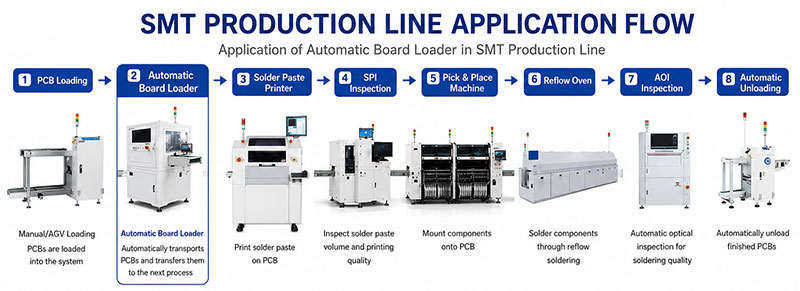
SMT assembly lines are one of the most common applications. An automatic board loader can transfer PCBs to processes such as solder paste printing, SPI, pick-and-place, reflow soldering, and AOI.
By automating PCB handling, manufacturers can reduce manual operations and maintain a more continuous production flow.
An automatic board loader can work together with PCB loaders, unloaders, buffer systems, and conveyors to create an automated PCB handling process.
A typical workflow is:
PCB Loading → Automatic Board Transfer → Production → Automatic Unloading → Buffer or Conveying
This configuration is suitable for electronics manufacturers looking to reduce manual handling and improve line efficiency.
Automotive electronics manufacturing requires stable production processes and reliable product traceability. Automatic PCB loading equipment can be used for vehicle control boards, automotive displays, and other electronic products.
Barcode scanning and equipment communication can also be integrated according to production requirements.
Mobile phones, tablets, smart devices, and other 3C products often involve multiple PCB models and frequent product changes.
A PCB automatic loading system can help reduce manual handling while connecting different production processes, making it suitable for high-volume and flexible electronics manufacturing.
For smart manufacturing applications, automatic board loaders can connect with AGVs, robots, MES, and SFC systems to support automated PCB logistics and production data management.
This allows PCB handling to become part of a larger automated manufacturing system.
When selecting an automatic board loader, manufacturers should consider PCB size and thickness, production cycle time, equipment interfaces, and automation requirements.
For factories handling multiple PCB models, equipment compatibility and changeover methods are also important.
Additional functions such as barcode scanning, AGV integration, and production data connectivity can be selected according to the requirements of the production line.
Shihao provides automatic board loaders, PCB loading and unloading equipment, buffer systems, and SMT automation solutions for electronics manufacturing.
Our equipment can be configured according to PCB specifications, production capacity, equipment interfaces, and automation requirements, supporting SMT, automotive electronics, 3C electronics, and other production applications.
An automatic board loader can be used in SMT assembly lines, PCB automated handling lines, automotive electronics production, 3C electronics manufacturing, and smart factory automation.
By connecting PCB loading, conveying, production equipment, and automated logistics, manufacturers can reduce manual handling and improve production efficiency.
19 years of focus on research and development as well as production