News
Our products are exported to over 30 countries.
Possess the full-process development capability from concept design to mass production and implementation

Possess the full-process development capability from concept design to mass production and implementation
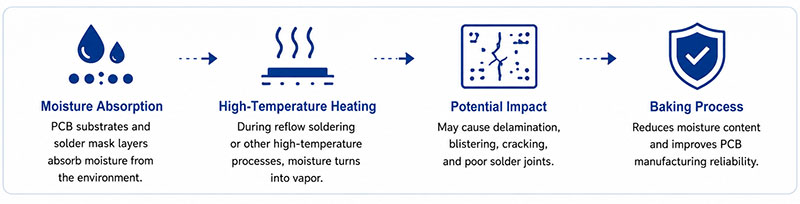
During storage and manufacturing, PCBs can absorb moisture from the surrounding environment. When a moisture-affected PCB enters a high-temperature process such as reflow soldering, the absorbed moisture may expand rapidly and affect board reliability or process stability.
This is why PCB baking may be used before certain high-temperature manufacturing processes.
The main purpose of PCB baking is to reduce moisture in the board through controlled heating.
PCB materials such as resin and glass fiber can absorb moisture under certain storage and environmental conditions. If excessive moisture remains in the PCB during high-temperature processing, it may increase the risk of problems such as delamination, blistering, cracking, or soldering defects.
However, not every PCB requires baking. The need for baking should be determined according to the PCB material, storage conditions, exposure time, manufacturer recommendations, and actual production requirements.
There is no universal PCB baking temperature or PCB baking time for all PCB types.
The appropriate process mainly depends on:
PCB material: FR-4, high-Tg, halogen-free and other materials may have different requirements.
Board thickness and structure: Different PCB thicknesses and layer structures can affect heat transfer and moisture removal.
Moisture exposure: Storage humidity, packaging conditions, and exposure time after opening can affect moisture levels.
Subsequent process: SMT assembly, reflow soldering, wave soldering, and other processes may have different requirements.
Therefore, manufacturers should follow the PCB supplier's specifications and validate the process according to actual production conditions.
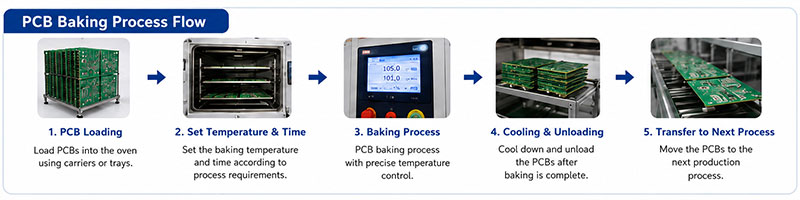
When selecting a PCB baking oven, temperature control and temperature uniformity are important factors. The chamber should also provide sufficient capacity for the PCB size, trays, and production volume.
For high-volume electronics manufacturing, PCB baking equipment can be integrated with automatic loading and unloading, conveyors, barcode scanning, AGV systems, and MES/SFC connectivity.
For more demanding applications, manufacturers may also consider nitrogen ovens, vacuum ovens, pressure ovens, or automated baking lines according to their specific process requirements.
Shihao provides PCB baking ovens, SMT baking equipment, nitrogen ovens, vacuum ovens, pressure ovens, and automated baking lines for electronics manufacturing.
Equipment configurations can be customized according to PCB dimensions, production capacity, process requirements, and automation needs.
For more information, visit our PCB Baking Equipment and SMT Baking Equipment product pages.
PCB baking is primarily used to reduce moisture before high-temperature manufacturing processes. PCB baking temperature and time should not be treated as universal fixed parameters and should be determined according to PCB material, moisture exposure, storage conditions, and manufacturer requirements.
Choosing a suitable PCB baking oven with stable temperature control, good temperature uniformity, and appropriate automation capabilities can help electronics manufacturers achieve a more consistent and efficient thermal processing operation.
19 years of focus on research and development as well as production