News
Our products are exported to over 30 countries.
Possess the full-process development capability from concept design to mass production and implementation

Possess the full-process development capability from concept design to mass production and implementation
In industrial curing processes, the choice between standard hot air curing and nitrogen inert atmosphere curing often determines final product quality and yield rates. Many engineers ask: "Does my product actually require nitrogen?"
This article examines the fundamental mechanisms of nitrogen in curing processes and provides clear selection criteria based on three critical application areas: new energy, semiconductor packaging, and precision metal processing.
As an inert shielding gas, nitrogen serves three critical functions in curing processes:
This represents the primary value of nitrogen curing. At elevated temperatures, oxygen in ambient air reacts with metal materials to form oxide layers. Nitrogen displaces oxygen, maintaining minimal concentrations (e.g., below 100ppm). A precision bearing manufacturer reported that implementing nitrogen inert atmosphere reduced workpiece oxide layer thickness from 15μm to 0.3μm.
Oxygen-free environments prevent surface discoloration, peeling, or oxidation spots. For consumer electronics structural components with stringent appearance requirements, nitrogen protection ensures consistent surface finish and color uniformity.
In certain material curing processes, nitrogen environments facilitate cross-linking reactions by preventing oxygen inhibition. For example, in silver paste curing, oxygen-free conditions prevent silver particle oxidation into silver oxide (Ag₂O), ensuring optimal electrical conductivity.
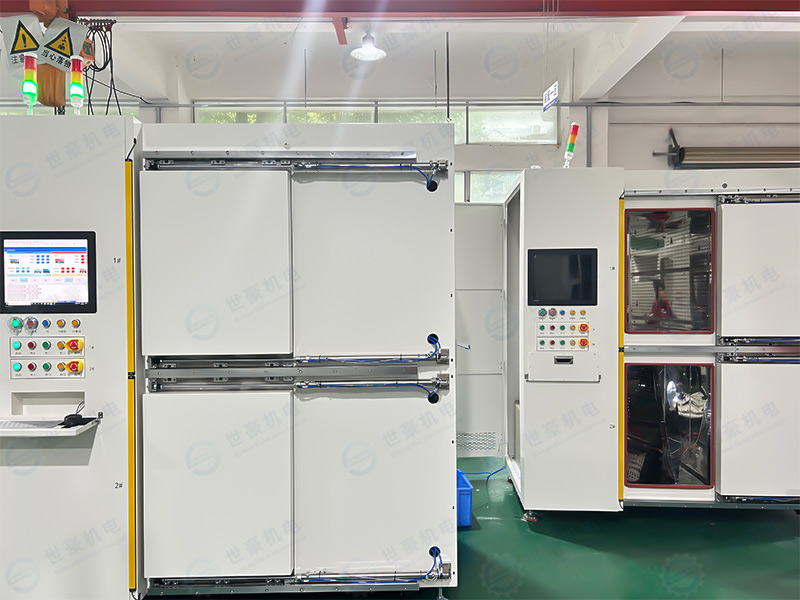
Electrode drying is crucial in lithium battery production. Nitrogen serves two essential functions:
Oxidation Prevention: Copper and aluminum foils oxidize readily at high temperatures, forming high-resistance oxide layers that compromise battery performance. Nitrogen inert atmosphere effectively isolates oxygen.
Enhanced Drying Efficiency: Research indicates that vacuum followed by nitrogen backfilling disrupts internal pressure equilibrium, forcing moisture expulsion with nitrogen. This "intermittent purging" process improves drying efficiency by approximately 30%. Additionally, nitrogen promotes uniform heat distribution, preventing electrode deformation or cracking from uneven heating.
Critical Parameter: A precision bearing manufacturer case study demonstrated that with nitrogen inert atmosphere, lithium battery electrode moisture residue stabilized below 50ppm.
Semiconductor packaging (including IGBT, SiC modules, BGA substrates, QFP packages) demands exceptionally stringent curing environments:
Power Semiconductor Modules: SiC and IGBT module packaging requires fully automated batch processing equipment with minimal residual oxygen and high cleanliness. Without these conditions, products oxidize, cleanliness standards fail, resulting in reduced curing efficiency and lower yields.
Silver Sintering Processes: Silver paste, a critical conductive material in semiconductor packaging, requires extremely controlled oxygen concentrations during sintering. Equipment must maintain oxygen levels ≤10ppm to prevent silver oxidation during sintering, ensuring formation of highly conductive, strongly adherent metallic bonds. A semiconductor packaging case study showed BGA substrates sintered at 180°C in nitrogen atmosphere improved solder ball void rates from 1.2% to 0.15%.
MLCC Sintering: Multilayer ceramic capacitors (MLCCs) sintered under nitrogen protection demonstrated 72% reduction in product warpage.
For precision metal component heat treatment, nitrogen protection is essentially standard:
Aerospace Components: An aerospace blade manufacturer implementing nitrogen inert atmosphere reduced scrap rates from 5% to 0.8%.
Tungsten-Molybdenum Annealing: In tungsten-molybdenum alloy annealing, nitrogen atmosphere improved tensile strength by 18% and elongation by 25%.
Carbon Fiber Composites: A carbon fiber manufacturer utilizing nitrogen curing reduced product porosity from 1.5% to 0.3%, while rapid cooling modules (15°C/min) tripled cooling efficiency.
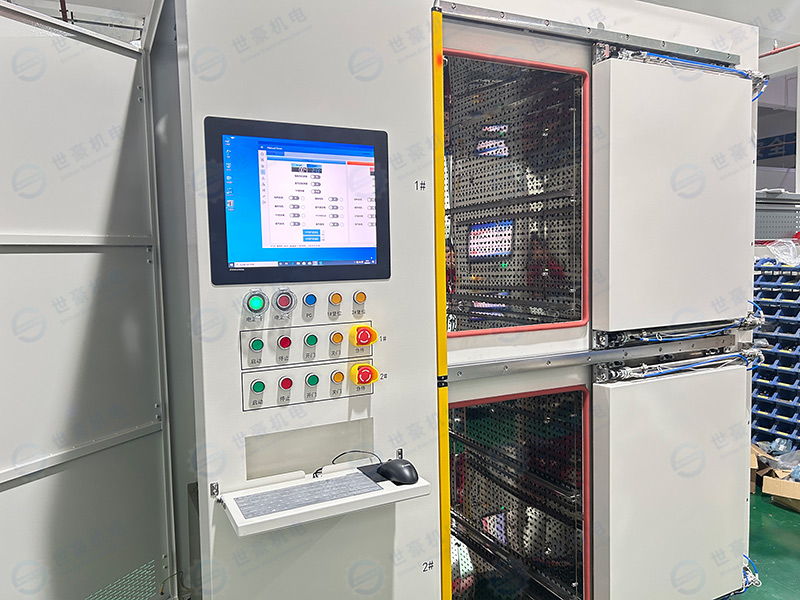
Many engineers mistakenly assume "nitrogen ovens are simply hot air circulation ovens with nitrogen piping added." In reality, fundamental manufacturing differences exist, as summarized in the table below:
| Comparison Aspect | Nitrogen Inert Atmosphere Oven | Standard Hot Air Oven |
|---|---|---|
| Chamber Fabrication | Full welding with high-temperature sealing to minimize leakage | Assembled or spot-welded construction without stringent sealing |
| Gas Intake System | No air intake—nitrogen inlet serves as sole fresh gas source | Dedicated air intake vents |
| Exhaust System | Adjustable exhaust; can be completely closed in non-contaminated applications | Fixed or limited adjustment; closing exhaust affects temperature uniformity |
| Piping Requirements | Seamless welded piping with pressure resistance, explosion-proof capability, and high-temperature tolerance | Standard industrial piping sufficient |
| Flow Control | Dual-flow control: high flow for rapid purging, low flow for maintenance to optimize nitrogen consumption | Not applicable |
| Heating Sequence | Delayed heating function—nitrogen purging precedes heating to establish oxygen-free environment | Heating begins immediately |
| Operating Cost Consideration | Sealing quality directly impacts nitrogen consumption (typically 3–4× chamber volume per hour) | No equivalent cost factor |
When evaluating oxygen-free curing equipment or nitrogen inert atmosphere curing ovens, prioritize these technical specifications:
Standard Industrial Applications: Residual oxygen maintained below 500ppm suffices for most requirements
Stringent Semiconductor Packaging: Requires ≤100ppm, with certain applications demanding ≤10ppm
Static vs. Dynamic Specifications: Distinguish between static oxygen concentration (no airflow) and dynamic concentration (operational)—the latter holds greater practical significance. Typical specifications: static ≤200ppm, dynamic ≤1000ppm
Temperature Control Precision: ≤±1°C
Temperature Uniformity: ≤±2°C to ±3°C; advanced systems achieve ±1.5°C
Chamber sealing design directly impacts long-term operating costs
Typical specification: Nitrogen consumption ≤12m³/h per chamber
Innovative exhaust gas condensation systems reduce nitrogen consumption by up to 40%
Semiconductor and precision electronics applications require equipment with high-cleanliness design to prevent particulate generation during transfer and curing
Achievable cleanliness standards: Class 1,000 to Class 10,000 (ISO 6 to ISO 7)
MES system integration capability for Industry 4.0 remote monitoring
Batch-level temperature-oxygen profile traceability ensuring process parameter CPK ≥1.67
| Case | Challenge | Solution | Result |
|---|---|---|---|
| Precision Bearings | 15μm oxide layer | Nitrogen<100 ppm | 0.3μm oxide layer |
| Aerospace Blades | 5% scrap rate | O₂ alarms >200 ppm | 0.8% scrap rate |
| Semiconductor Packaging | 1.2% void rate | 180°C nitrogen curing | 0.15% void rate |
Challenge: Post-heat treatment oxide layer thickness reached 15μm
Solution: Implemented nitrogen inert atmosphere with oxygen concentration maintained below 100ppm
Result: Oxide layer thickness reduced to 0.3μm
Challenge: High-temperature processing caused oxidation-related scrap rates of 5%
Solution: Introduced intelligent oxygen analyzers triggering alarms when oxygen exceeded 200ppm
Result: Scrap rate reduced from 5% to 0.8%
Challenge: BGA substrate curing resulted in solder ball void rates of 1.2%
Solution: Implemented 180°C nitrogen atmosphere curing
Result: Solder ball void rate improved to 0.15%
Which processes require nitrogen? Use this decision matrix:
| Application Area | Nitrogen Requirement Criteria | Recommended Oxygen Concentration |
|---|---|---|
| Lithium Battery Electrodes | Copper/aluminum foil oxidation risk at high temperatures | ≤100ppm |
| Semiconductor Packaging (IGBT/SiC) | Electrode oxidation compromising electrical performance | ≤10-50ppm |
| Silver Sintering | Silver particle oxidation affecting conductivity | ≤10ppm |
| Precision Metal Components | Surface oxidation affecting dimensional accuracy | ≤100-500ppm |
| Standard Structural Components | Minor surface oxidation acceptable | Standard hot air sufficient |
Oxidation prevention curing solutions fundamentally balance equipment investment, operating costs, and product quality requirements. If you're addressing product oxidation challenges or seeking oxygen-free curing equipment recommendations for specific materials, our process engineering team welcomes your consultation. We offer complimentary sample testing services and customized nitrogen inert atmosphere curing solutions.
19 years of focus on research and development as well as production